Waiting for Weather in Belhaven
Text by Paul Clayton, Photographs Paul Clayton and David Swanson.
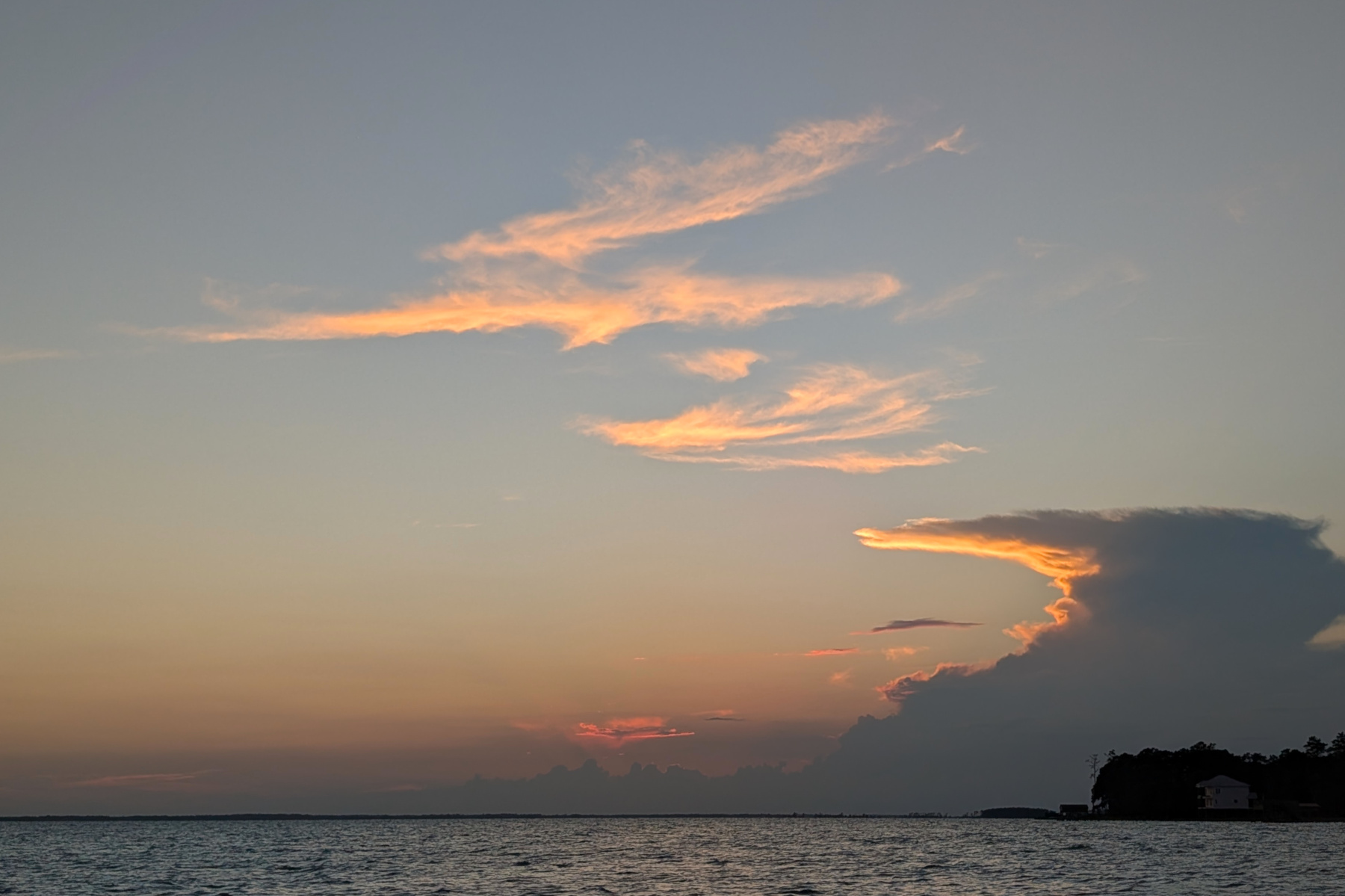
For three years running, sailing partner David Swanson and I have made a week-long fall trip aboard my Alberg 35 Terry Ann. For our 2026 trip I had an ambitious idea that with perfect conditions we could run from Washington up the sound to Manteo and then loop around the Albermarle and come back through the Alligator-Pungo. That door got slammed by a low pressure system developing off the coast that promised northeasterly winds for at least the first few days of our trip.
 |
It had been a brutal summer of unremitting heat, and I had not been down to Washington since April. I got down a few days early to get the boat in order, make sure all systems were working, offload anything we weren't going to need (the air conditioner) and (gag) fill the fuel tank with $6.29/gallon diesel. A few hours were left to drive to Edenton and meet up with Taylor and Ben, who were racing.
By the time David and I departed Washington on 9/21, a true equinoctal storm was brewing and our options were to stay around the Pungo River area or ride the winds to Oriental. We didn't have to decide the first day. Depending on the following morning's forecast, we would turn north up the Pungo or south down Goose Creek. We knew we could do either one, the question was, if we went to Oriental, could we get back? Most of these northeasters blast through and disappear up the coast, but sometimes they linger. Conceivably, we could be trapped in Oriental for a week, with heavy northeast winds and the always-challenging Maw Point corner at the three-way intersection of the Bay and Neuse Rivers with the Pamlico Sound between us and Washington. There are worse places than Oriental to get hung up, but even we retired gentlemen have time constraints.
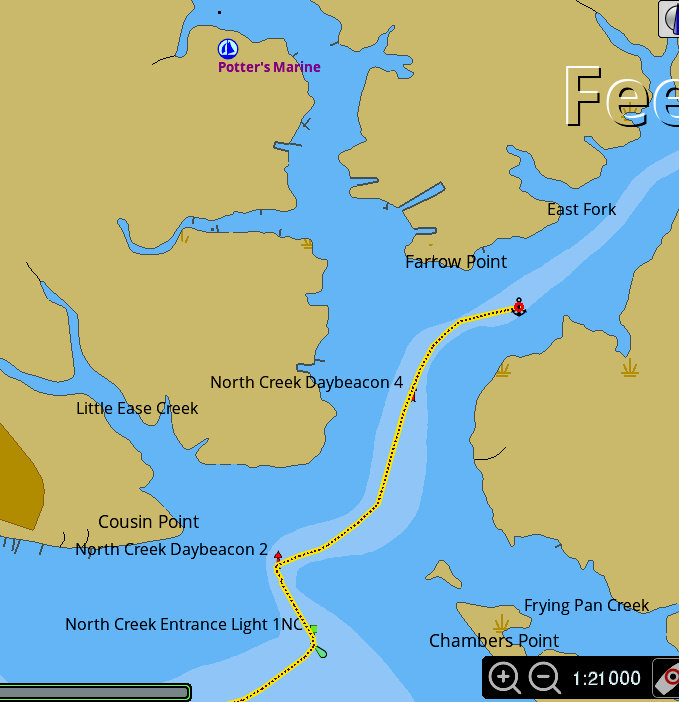 |
We got off the dock about 11:30 and, while we might have rolled the jib out for a short time, with light airs mostly dead ahead, we sedately motored down the river at a steady 3 knots. Neither of us was particularly enthusiastic about putting in at Bath. Nothing wrong with Bath, but it is the easiest and quickest overnight trip from Washington or David's home port of Potter's Marine, and we'd both been there more times than we could remember. David pointed out Durham Creek just across the river from Bath and noted that it was a good, fairly secluded anchorage but it was early and we wanted to get a few more miles down the river. Then David suggested we might go in North Creek where his marina is located, but turn up the east fork. He hadn't been up there himself, but had heard it made a good anchorage. Sounded good to me, so in the dying light of the day, we made the curving trek in. The creek mouth has a reputation for being difficult. Sailors follow a course directly between Markers 2 and 4 and get aground on some shallow water to the west. With a chart plotter it's no big deal. We saw some shallow water immediately inside Marker 1, but the next day on our way out found plenty of water just a few yards over, away from the rhumb line between Markers 1 and 2.
It was getting dark when we dropped anchor, 23 nautical miles from the Washington dock. I handled the ground tackle with David at the helm, backing down under wind and light throttle. I had the satisfaction of feeling the big Fortress ride along the bottom just a few feet before the flukes dug into the bottom, bringing us to a halt. We were glad to be in protected water as lightning flashed far off on the west and south horizons. I set an anchor light before heading below, closing the companionway with the mosquito screen, and cooking dinner.
In the morning we ate a quick breakfast, hauled anchor and motored out into the Pamlico River. The wind was blowing strong out of the northeast, so we set the jib, shut down the motor, and rode the breeze on a long, slanting board to a point off Indian Island, where we rolled in the sail, started the motor and hardened closer to the wind to make for the mouth of the Pungo River. Once we turned up the river, we were able to reset the jib, now on the starboard tack, and motor-sail to Belhaven.
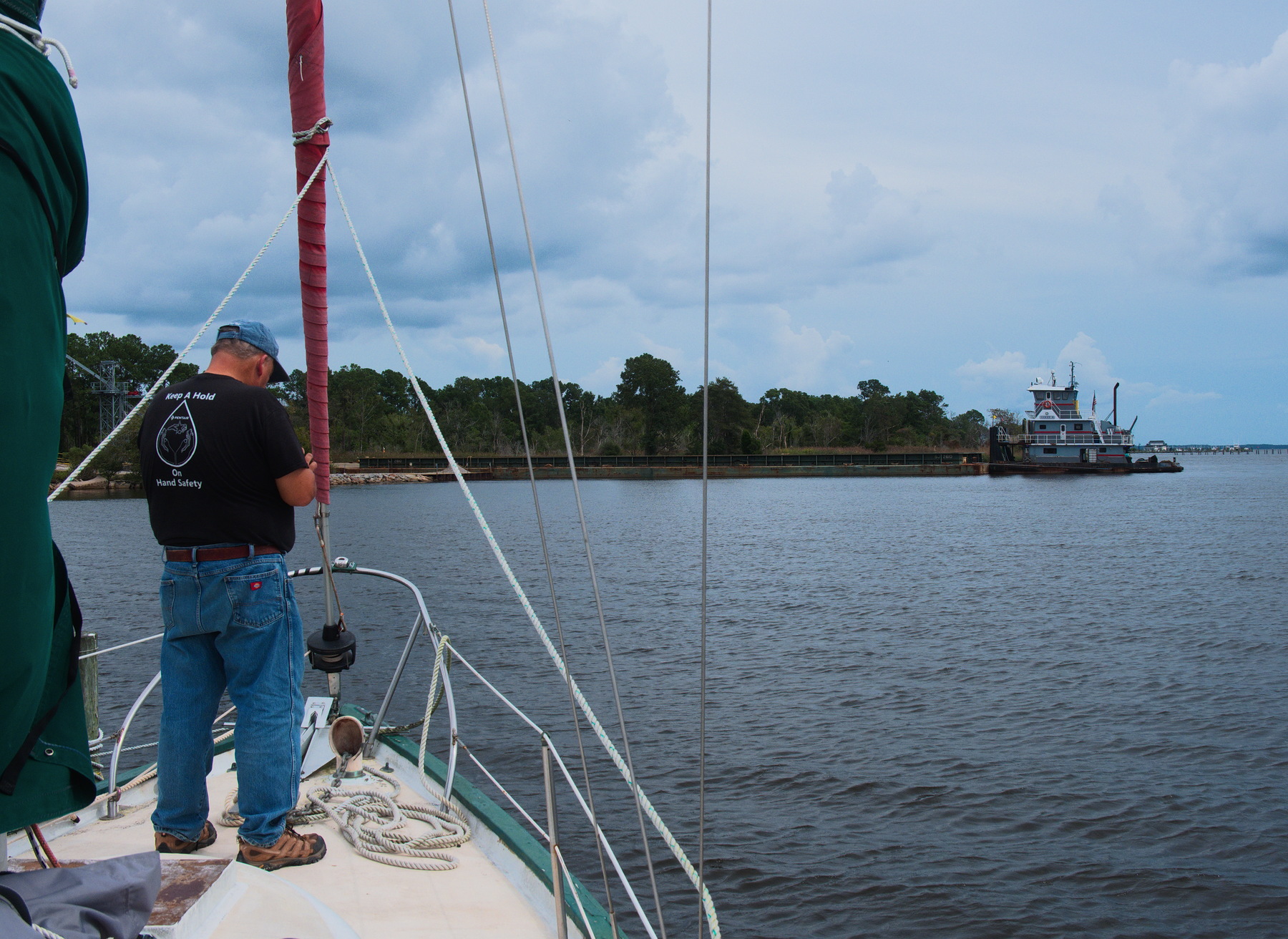 |
We carried the jib right up the Belhaven waterfront and tied up on the Cooperage Dock. There were a few boats in the anchorage and a few at the marinas, but with the increasingly threatening weather forecast I was surprised not to see more. One unexpected visitor was a barge tow tied up to the grain mill dock. In all my years of visiting Belhaven I had never seen that before. Cindy R. was built in 1980 in Vinton LA, purchased in 2024 by Ward Towing Company of Deltaville VA. Whether she was transloading cargo or just waiting for weather before proceeding I don't know. All the details about the boat are available at Tugboat Information.
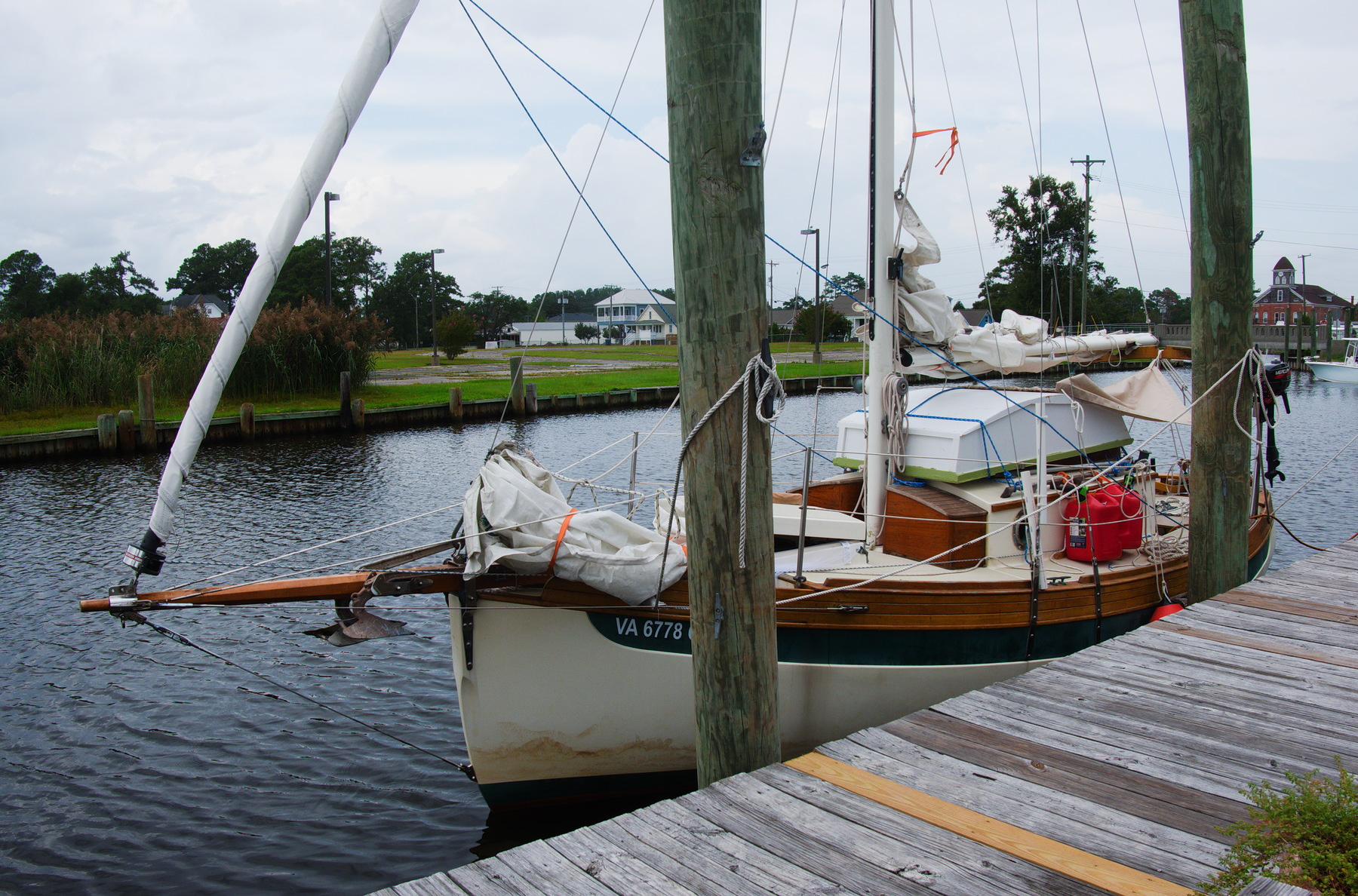
No real weather yet, but foreboding nevertheless. NOAA radio reported gusty winds, high water and rain in Oriental, deteriorating conditions on the Banks. It had been a dry summer and the usual swamp between the Cooperage Dock was waterless, but if we got rain in Belhaven it would quickly flood. We decided to walk in to town, check out the sights and maybe run by TJ's and see if we could dock there for a few days. On the Wynne's Gut dock we found a Lyle Hess Bristol Channel Cutter Keiki with Virginia registration but Newport Beach, CA hailing port. Over at Belhaven Marina we found several power cruisers and one steel boat that looked like it might be a research vessel.
 |
TJ agreed that we could move the boat the next day to his new dock for the marina he is building adjacent to the boatyard. That pretty much finished our responsibilities for the day. We took a turn around the boatyard and spoke to my friends Steve and Renee aboard their big Endeavor. Afterward we started hiking back to Cooperage Dock in what David calls a spitting drizzle. Steve and Renee on their way to the store in their brand-new mini-van came driving up and gave us a ride. Just after they dropped us off we realized we wanted to go back into town, so we turned around and walked back in! It was after 4:00 so the ICW Brewery downtown was open for business. We went in and found a new to me arrangement where you can tap your own beer and a card meters the ounces, and then you pay at the end of the session. That makes it easy to sample before you fill a glass, and lets you drink just the amount you want. It's also harder to keep track of how much you have had, making the tab larger. I sampled a beer or two and settled on an IPA, while teetotaler David had a soft drink. There were a few locals at the large communal table and we had a pleasant conversation. Then it was back to the boat to cook supper.
The next day dawned more of the same, only more, as the winds picked up a bit, the sky turned grayer, and an occasional light shower swept over. We started by walking into town and having breakfast at Ginger Bread Bakery, which we both agree is the best breakfast place in Belhaven. David had a massive plate of bacon, eggs, fried potatoes and toast while I enjoyed two biscuits covered in a delicious gravy the consistency of carpenter's glue, leaving both of us certain of adequate calories for the morning. Washed down with multiple cups of coffee.
 |
By mid-morning the weather was going down fast and we decided to get moving. We would have to come out of the shelter of Belhaven Harbor and motor straight into the wind to the mouth of Tooley's Creek. There we would have the slight wind shadow of the adjacent swampland, and our only concern would be negotiating the tricky shoal channel into TJ's.
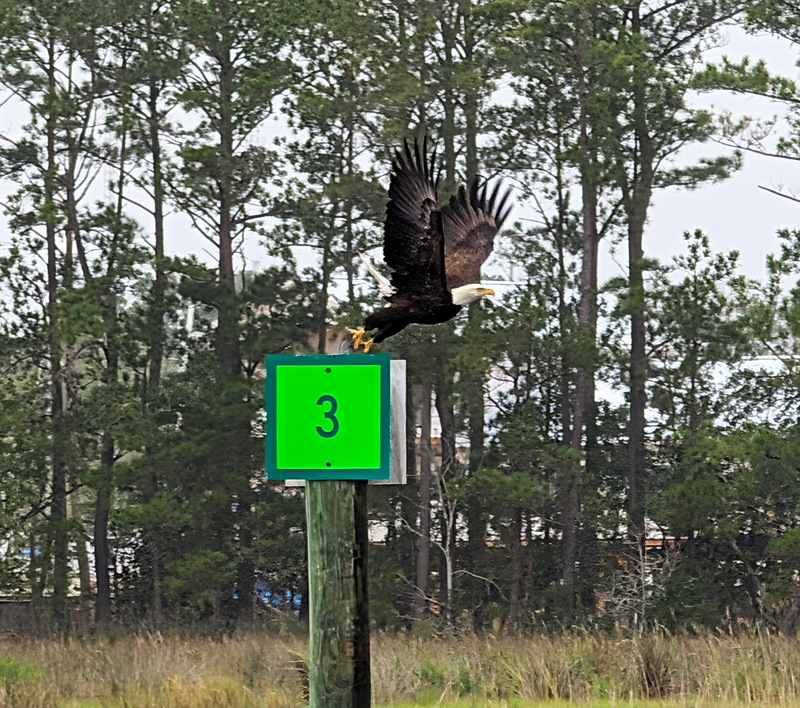
We were pleasantly surprised to find new markers leading into the creek, which made the navigation almost trivial. Every other time I have been in or out of that channel we have touched bottom, but this time was smooth sailing. We found out later that TJ had placed the markers at his own expense, as well as dredging, frantically getting what he could done in a short two-week window that the authorities had granted. The markers are not yet charted but believe me, they are there and a big help. As we slowly motored in, David got a shot of a bald eagle launching off brand-new Marker 3.
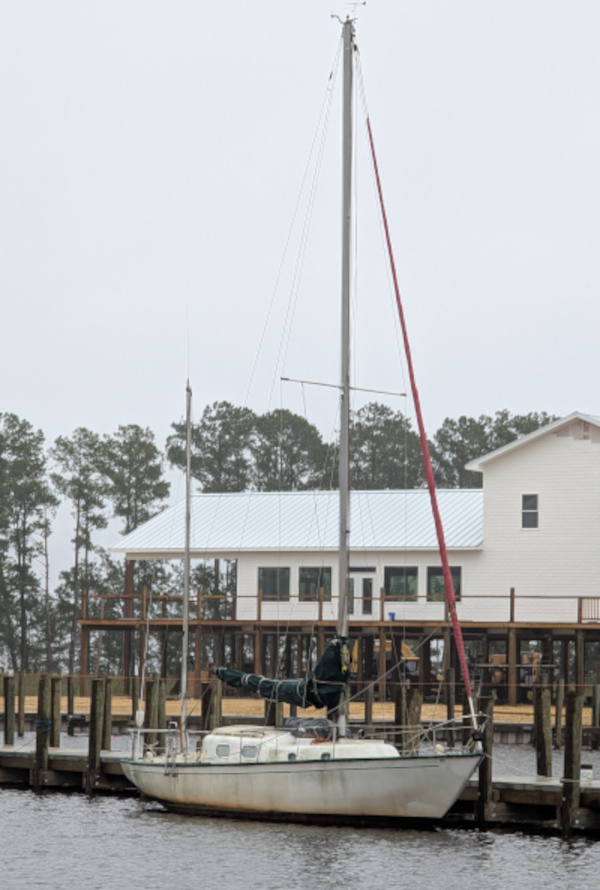
Adjacent to the boatyard, TJ is in the process of constructing a marina. The interior basin has been cut out and dockwork completed. A big, fancy clubhouse and office is taking shape, and a few guest cabins for transients looking to spend a few days ashore. We laid Terry Ann on a face dock along with two other transients sheltering from the weather. We got her well-lined and sprung with fender board in place and a few supplementary fenders and could feel that the boat was secure. We walked up to the boatyard office to sign in and get the codes to the shower room and wifi. I asked about buying a bag of ice, and the girl who helps out in the office told me I could, and she would get it for me from the ice machine in the office, rather than the big ice locker on the porch - because, "There's birds in there". Like, in the fan housing in back? "No, inside." So, what kind of birds? "I think they're turkeys", she replied with a tone of mild aversion. So maybe somebody had been hunting, or preparations were being made for Thanksgiving. Later I talked to Crystal (Mrs. TJ) and found the rest of the story. The whole family had put in for swan permits and all had received one. They all got their birds in the hunt. She had given her bird to a friend who likes to roast swan, but her husband and kids refused to part with theirs, so they were frozen until the taxidermist had time to mount them. I told her they should place the mounted birds on pilings in the marina to scare away seagulls, but I don't think that is going to happen.
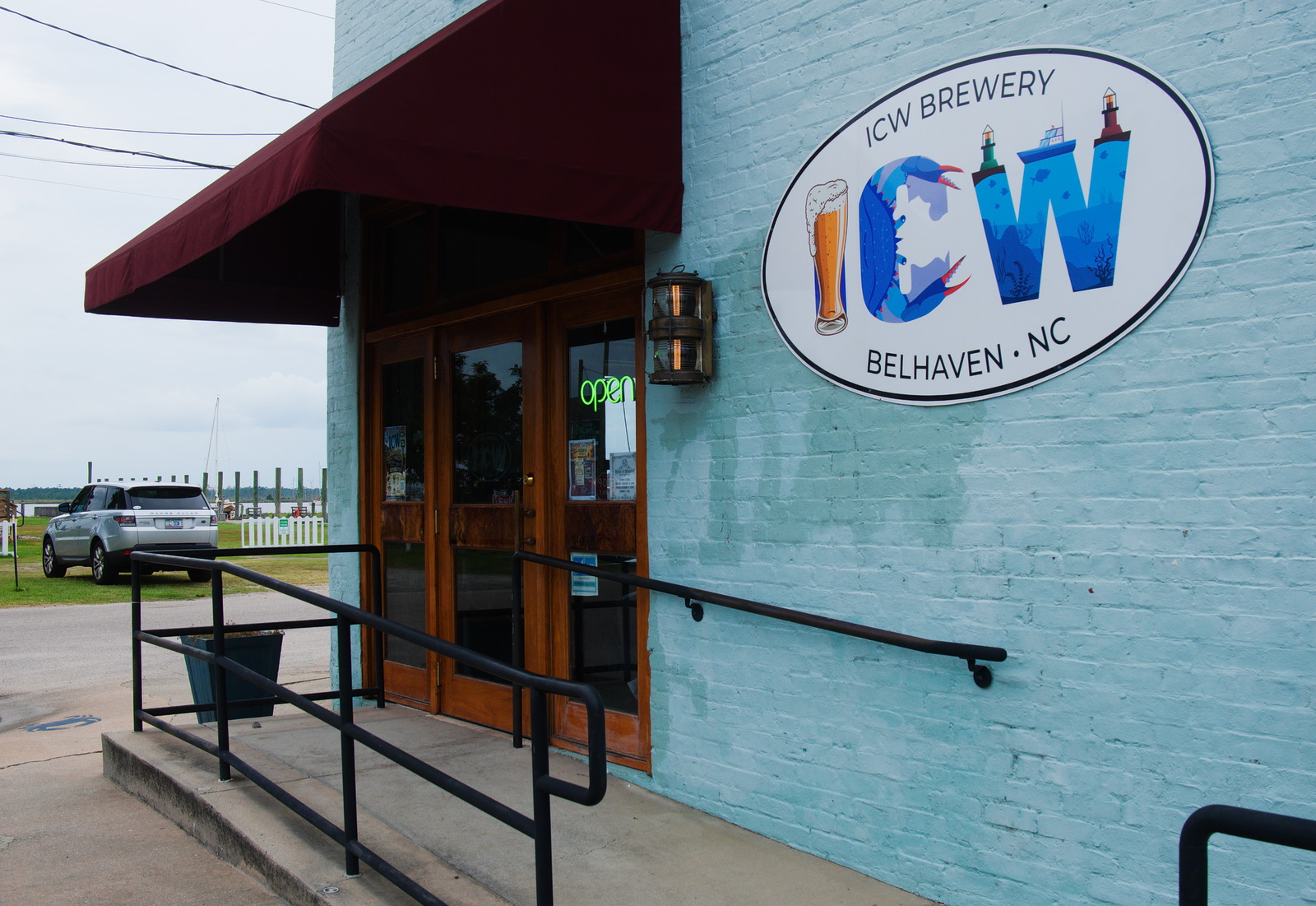 |
By now it was after 4:00 so the brewery was open. We entered, me with enthusiasm and David with resignation, and found contingents from two of the big trawlers docked across the street at Belhaven Marina. Fine folks and good sailors they were, and we had a pleasant conversation about our home ports and wanderings. After a while a younger couple came in, and we quickly appraised them as coming from the steel boat. They were friendly, and soon we found out their story - not far off from what I had thought on first seeing the boat the day before. The AdriftProject is a "Floating Artist Residency", a bonafide 501(c)(3) that can operate relatively tax-free and accept deductible donations from all and sundry. In other words, a splendid way for a young couple not born to money to do something worthwhile and help finance their life of maritime travel. I'll let you read about it (and maybe make a donation) at their website
Back at the boat for dinner, we followed the news from Island Free Press of deteriorating conditions on the Outer Banks, as in Belhaven the drizzle continued to spit and the wind to blow and sometimes whistle in the rigging. In Ocracoke, prescient visitors were boarding the ferries for Hatteras and the mainland as the waves began to slop over Highway 12 north of the pony pens. Once the highway became impassable, the ferries to Hatteras ceased, and not long after, as conditions worsened on the open waters of the sound, the ferries to the mainland shut down as well.
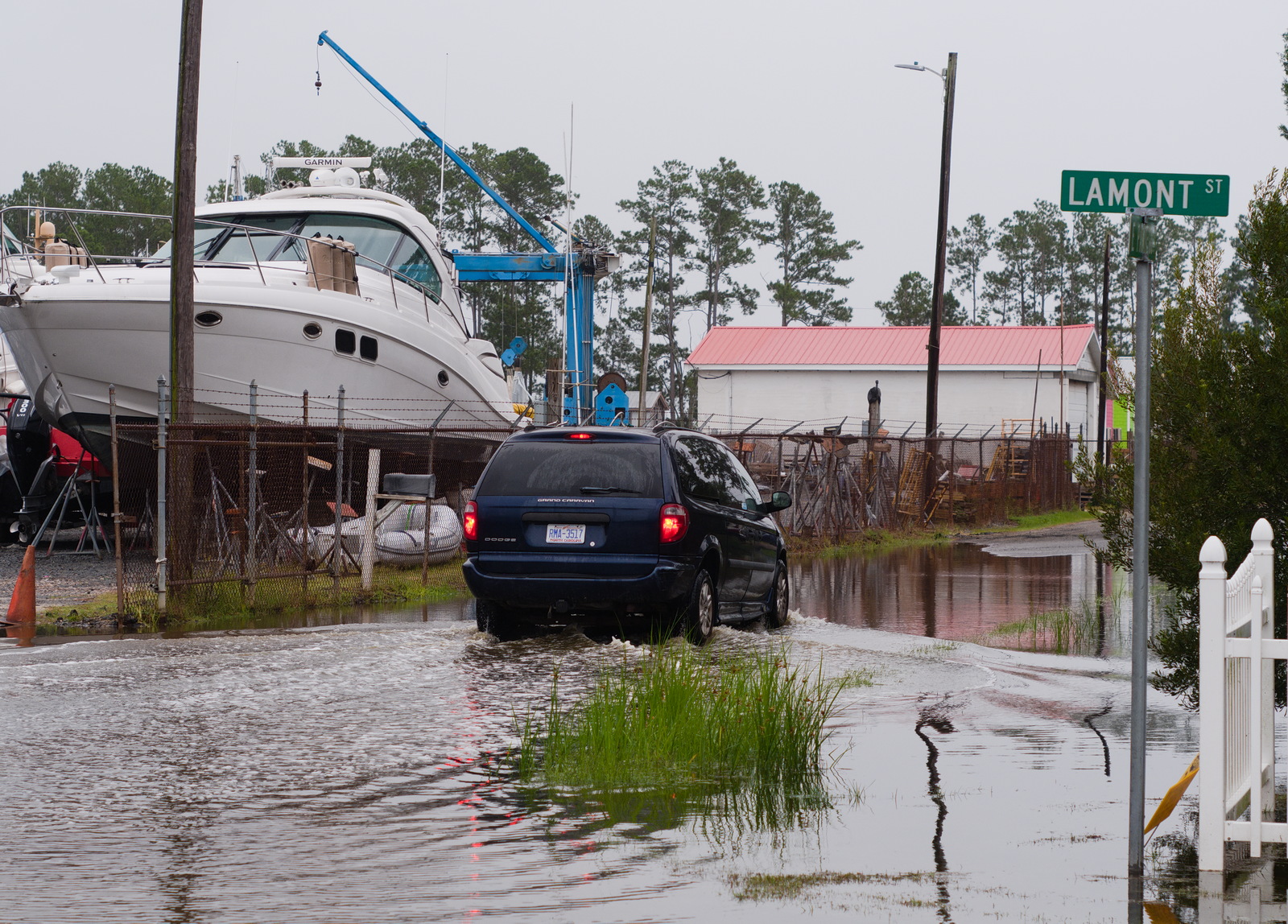 |
Thursday is when things really got cooking on the Banks, with 50 knot winds and heavy ocean overwash. All ferries were suspended, and worse, Highway 12 in the vicinity of the National Park Service Visitor Center was severely damaged and cut. That stranded hundreds of tourists with no way to get off Hatteras Island either north or south. The state immediately started the process of activating the Stumpy Point-Rodanthe emergency ferry route, and did in fact have it in operation in a couple of days, bringing in food and other urgently needed supplies and taking a few cars back to the mainland (most room reserved for returning supply trucks, garbage trucks and other emergency traffic). Back in Belhaven, we saw some minor street flooding, but nothing like what we expected. Due to the direction of the wind, the heaviest soundside flooding was off to the south side of the sound, and there wasn't much of a surge up the Pamlico River. It also helped the area that there wasn't much rain with this storm.
David offered to foot the bill for dinner and I gratefully accepted. He and his wife enjoy dining out and he knows all the good places. We decided on The Tavern at Jack's Neck, (not that we had much choice) and had a perfectly acceptable pizza after an interminable wait. The waitress took one for the team and claimed that she accidentally knocked our pizza over in the kitchen and they had to re-make it, but there might be more to this than meets the eye. Regardless, it was pleasant to watch the Asian Fencing Championships on the big screen while listening to '80s classics and doing some light people-watching. The best was the pre-teen doing dance steps to "Kung Fu Fighting". Neither of us realized this was still a thing.
 |
Friday still too windy to start for home. I suppose we could have run down the Pungo under the jib and dodged in behind Indian Island for the night but discretion being the better part of valor we decided to lay over another day in Belhaven. The nor'easter was starting to lift up the coast but the Banks were still getting pummeled. We heard horrifying rumors that 200 cars were waiting in Rodanthe for the Stumpy Point ferry or for Highway 12 to reopen to the north, locals going car to car and giving people bottles of water. The NCDOT was working frantically to get a lane open on Pea Island and late in the day succeeded in clearing a lane on Ocracoke Island, allowing the Hatteras-Ocracoke ferry route to resume service, and the slightly better weather meant the cross-sound ferries were back in operation. The Ferry Division was only allowing Ocracoke residents and supply vehicles to enter Ocracoke from the north, plus a limited number of cars with reservations on the Cedar Island and Swan Quarter ferries. This nightmarish situation continued through Friday and finally ended when NCDOT got one tenuous lane open on Pea Island and started allowing cars north, alternating directions every few hours for supplies to come in.
Incidentally, nobody was moving in Belhaven either. I could see several of the boats, including the barge tow, on ShipTraffic.net, which tracks vessels by AIS, and everyone was staying put.
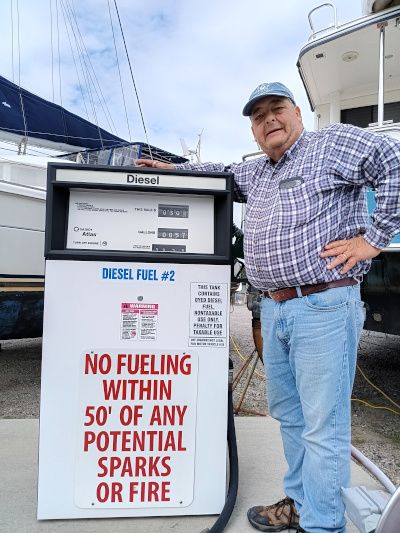
Saturday was forecast to be better, so we started making preparations to return to Washington. The motoring on the trip out had consumed 9 gallons of diesel, and I had 2 gallons in the can, so that went in first. Next we walked over to the boatyard for another load. The TJ's pump is on a high platform to keep it from getting flooded in high water. David climbed up onto it, zeroed the meter and handed down the hose, looking for all the world like Goober Pyle, except for the hat. I pumped five gallons of pink diesel, legal for marine use, into the can, and then we borrowed one of the yard golf carts to run it around to our dock. I added it to the tank, giving us 18 gallons to get home, which should be gracious plenty, even if we had to motor the whole way.
 |
Groceries were getting low so we trekked into town to visit the new butcher shop. Crystal had clued us in to try the infused pork chop. The one we bought was around 3/4ths of a pound, plenty for both of us. The butcher rendered pork fat, mixed it with lemon juice and seasonings, and injected it into the meat. We stopped by the bakery and got a loaf of bread. Back at the boat we fried the pork chop and made up some potatoes and carrots to go with it.
No denying it, by this time we had taken everything Belhaven had to give. After another evening of lounging around the boat, reading and checking the weather, we were ready to cast off lines in the morning and at very least run before the northerly wind down the Pungo. If we couldn't beat back up the Pamlico, we'd just run across it and tuck in Bond or South Creek for the night.
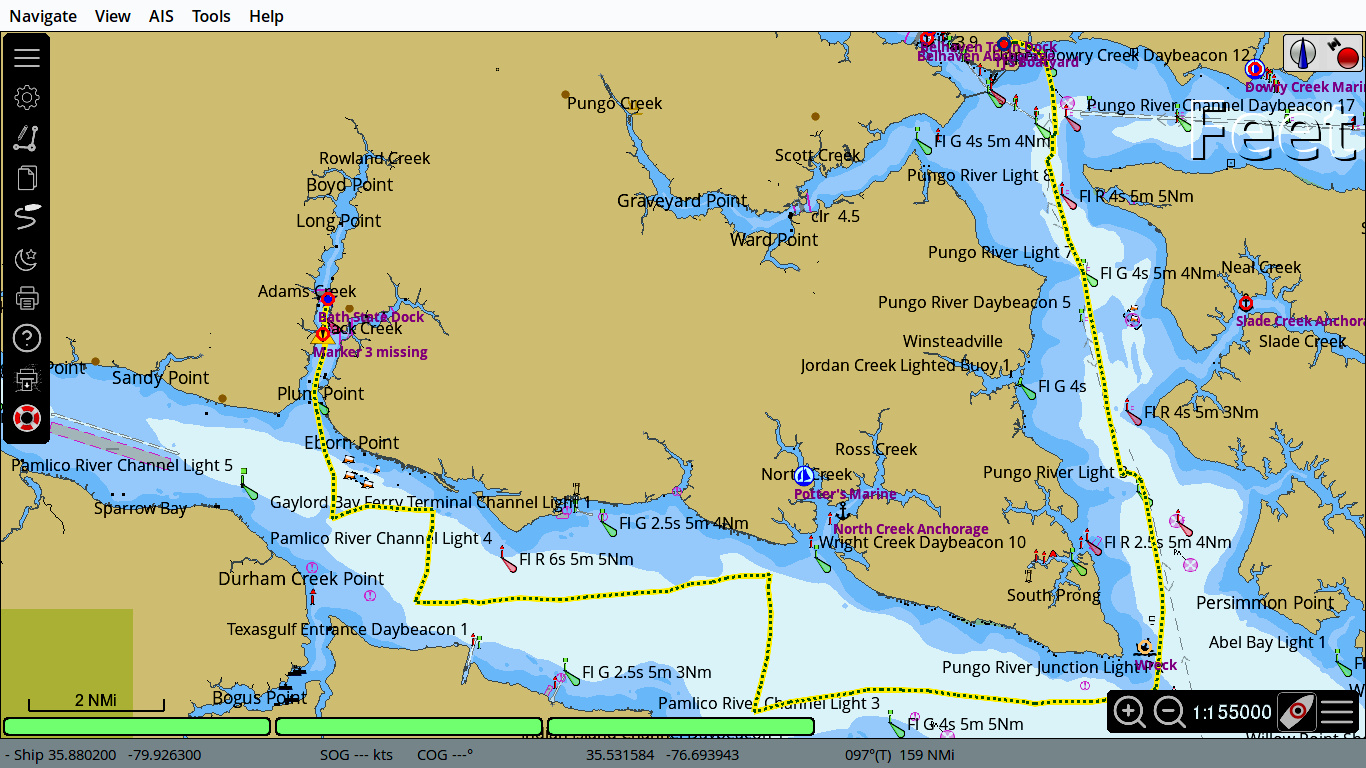
We got off the dock at 8:00 Saturday morning after a quick breakfast of bread, cheese and coffee. I really expected to run under jib only, which doesn't excuse me neglecting to put a reef in before we left. Once we got out of Tooley's Creek into the river, the temptation to do some real sailing was too much, so we raised the main, rolled out the jib, shut down the motor, and tore off down the river on a broad - very broad - reach. We had just enough angle with the wind out of the north by northwest to avoid an accidental jibe. While Terry Ann's hull was in desperate need of a cleaning, the 20+ knot wind was plenty to give us 5 to 6 knots all the way. Shoulda' put a reef in.
Once we turned the corner at Pungo River Junction we were close-hauled and rail down. We held a course of due west as far as Hickory Point, where the water began to shoal, and then tacked back to the north. The conditions were rough, so we put the engine on to help us through the tack, and ran it at low rpm all the way to the mouth of Bath Creek. Back on the north side of the river, we tacked again and beat to the shallow water at the mouth of Durham Creek, then tacked back to the north side of the river. We tacked again and sailed past the artificial reef off Eborn Point, where we turned into Bath Creek, dropped sail and advanced the engine to standard 2700 rpm for the final segment of the day's voyage to the State Dock.
 |
On the first board to Hickory Point, David, at the helm, calmly pointed out that the port upper shroud was unattached at the turnbuckle. My heart stopped as I saw the shroud swinging in the wind. Fortunately we were on the starboard tack and I gave David the unnecessary instruction to maintain course (he knows in this situation to keep the port side to lee, just as he did when we broke the port spreader after a knockdown on the Albemarle). I grabbed some tools and crawled out on deck where I found to my relief that nothing was broken, the fitting had just backed out of the turnbuckle. I was able to reach out over the rail and grab it. I screwed it back in place but had to make a second trip with more tools to get it tightened up adequately. At this point I noticed that none of the turnbuckles were pinned, so I went over all of them, making sure they were tight and wrapping them with tape tell-tales that I nervously watched for movement the rest of the trip. For some reason the last time I set up the shrouds I failed to pin them. I can only plead stupidity.
We were definitely over-canvassed the whole day but it did make for some fast sailing. We covered 31 miles in 8 hours, close enough to a 4 knot average to call it that, especially considering that includes creeping out Tooley's Creek in the morning and working sail both ends of the trip.
I walked up to Blackbeard's and found them packed, with several parties waiting at the bar, but the hostess graciously filled my ice bag. (A hint for transients - I have found bars, restaurants and coffee houses to be generous about giving sailors ice, but be sure to bring a clean canvas or sailcloth bag.) Back at the boat, we had reserve rations of Rice-a-Roni.
In the morning we walked to Old Town Country Kitchen for breakfast. Back at the boat, we got ready for the last day's sail, and were off the dock by 9:00. Out on the Pamlico we raised sail and made three tacks with the wind blowing straight down the river, then gave up, dropped sail and motored the 18 miles to Washington. Coming downriver with a fair wind were a stream of sailboats, out for the weekend, or longer if they were lucky.
We tied up and David threw his bags on the dock and raced off to Apex to handle some issues on the home front. I stuck around for a couple of days, getting the boat in order and pinning all the turnbuckles.
David and I were in agreement that we made the right decision in not going south to Oriental. Trying to sail back against the prevailing northerlies would have been, if even possible, a slow and unpleasant task, especially coming out the mouth of the Neuse, rounding Maw Point and running up the Bay River. I could have laid over in Oriental a few more days until the wind turned, but David had time constraints and would have had to arrange a ride back to Washington, leaving me to single-hand the boat home. I've done it many times, but as the advancing years take their toll, I find that I much prefer having crew.
Despite the short sailing mileage, I greatly enjoyed this trip. I can't speak for David but I hope it was at least entertaining enough to do it with me again next year. I saw a new anchorage in North Creek and met some sailors. I think my favorite mode of sailing is to spend a couple of days making a passage and then lay over in port for a few days.
Here are a few more pictures.
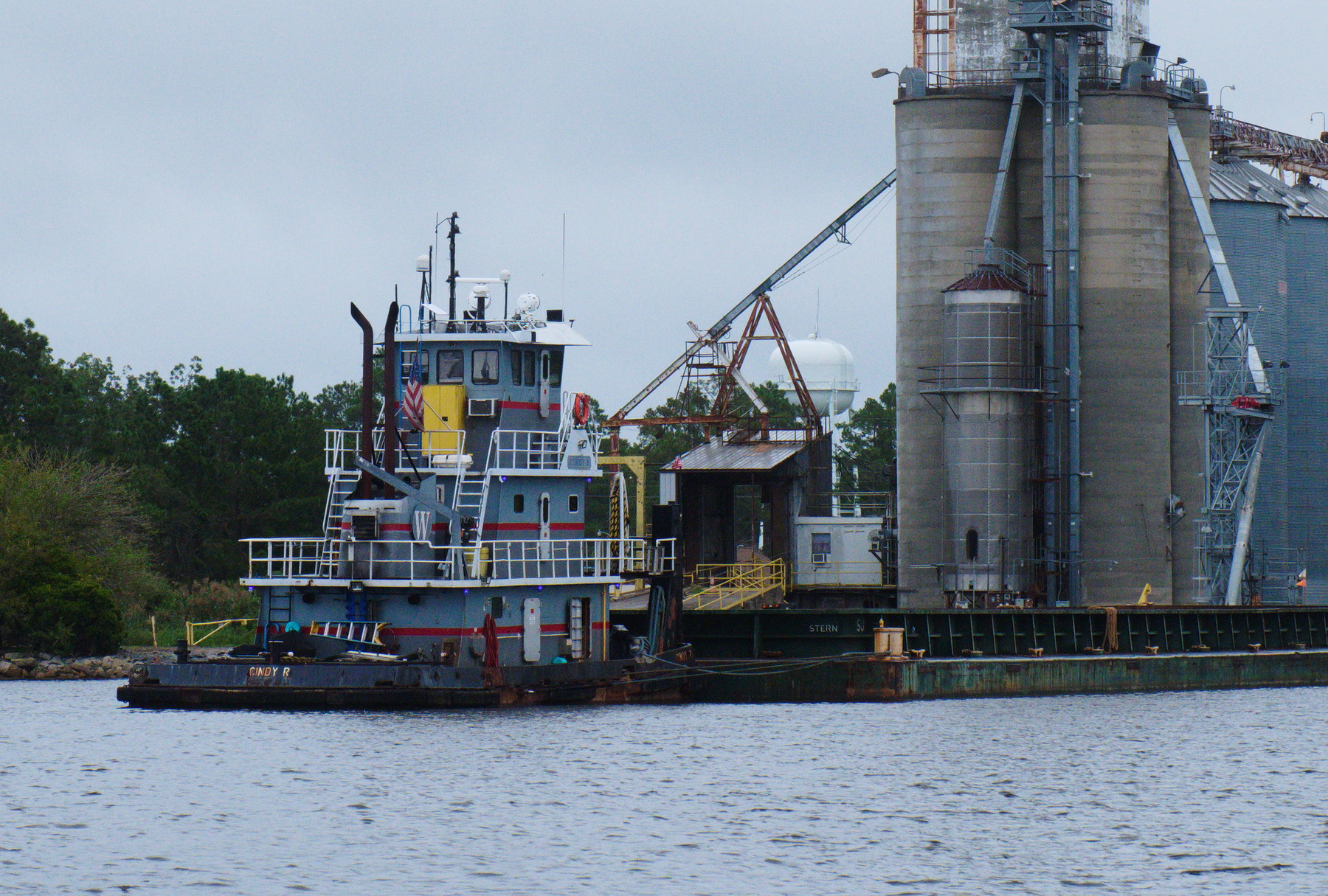
Barge Tow at the Mill in Belhaven. Photograph by Paul Clayton.
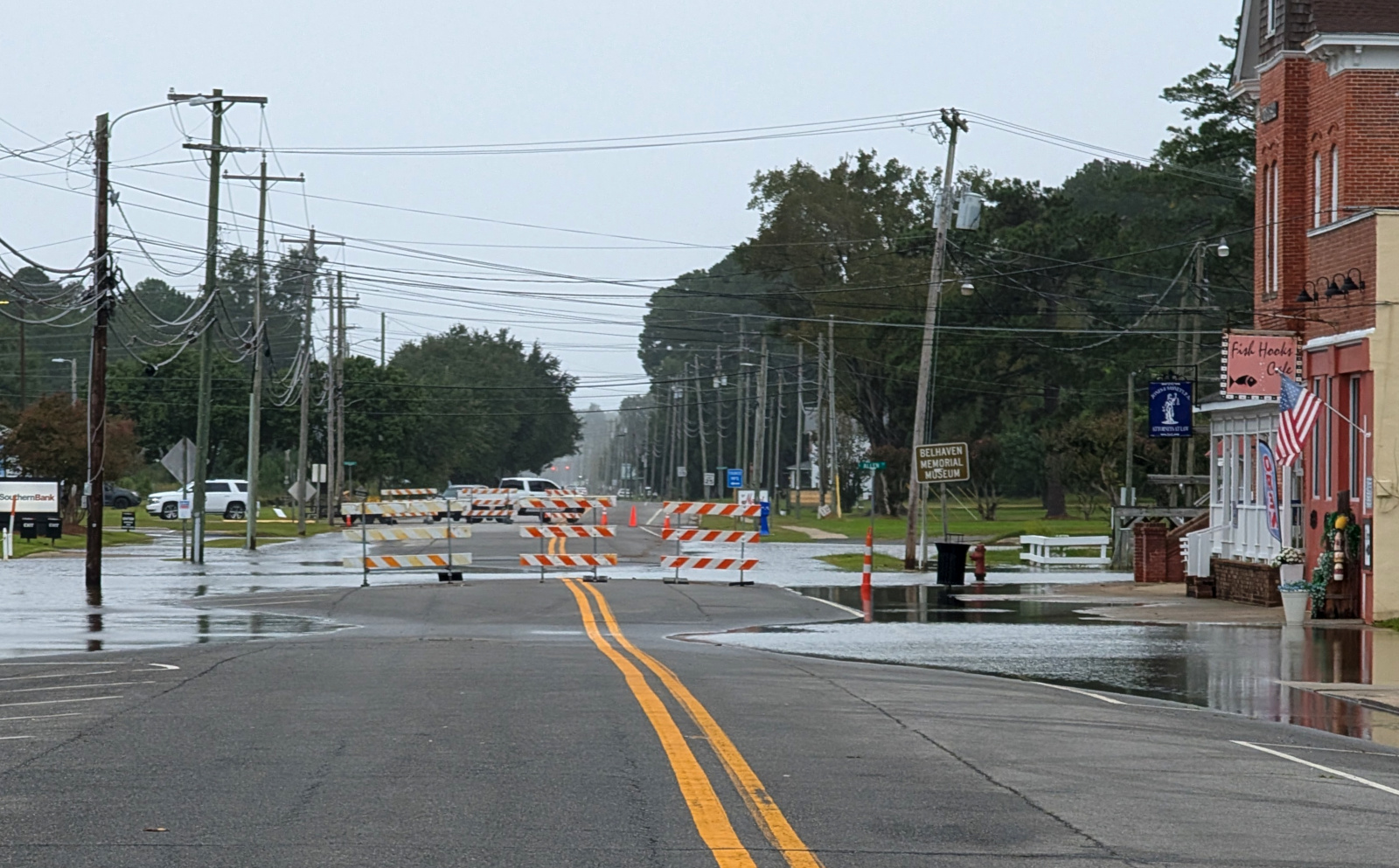
Street Flooding in Downtown Belhaven. Photograph by David Swanson.
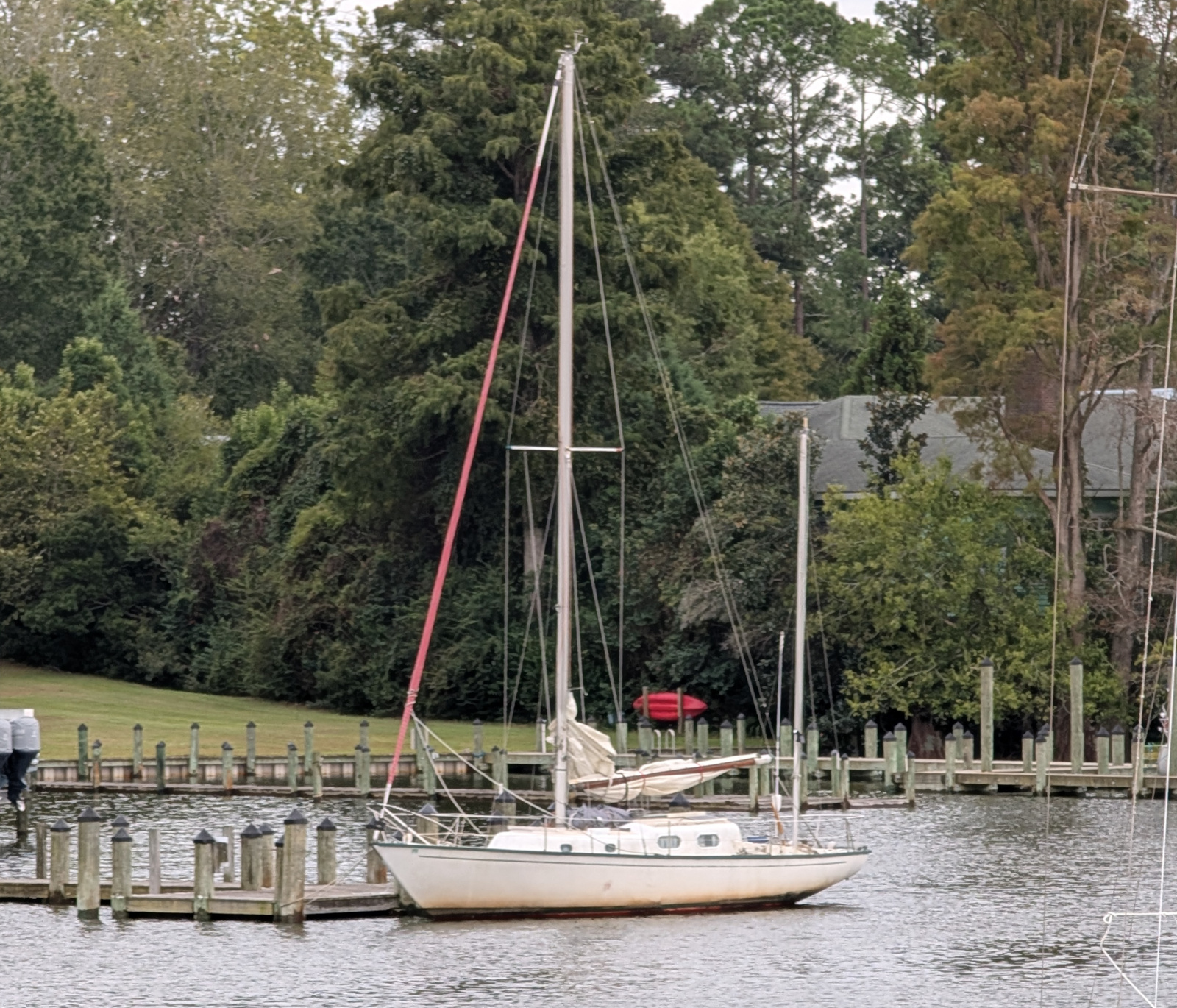
Terry Ann on the State Dock. Photograph by David Swanson.
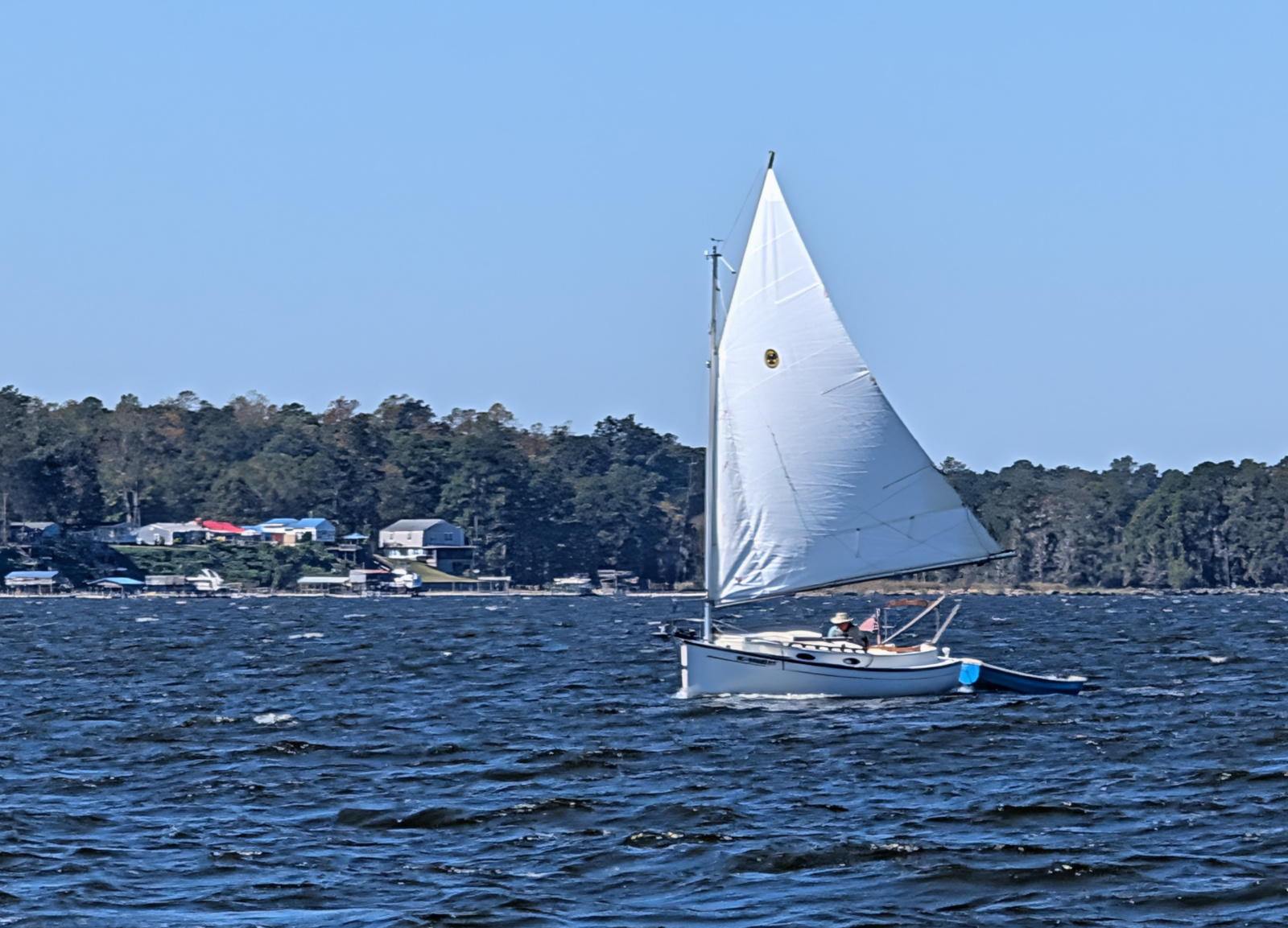
Com-pac Catboat. Photograph by David Swanson.
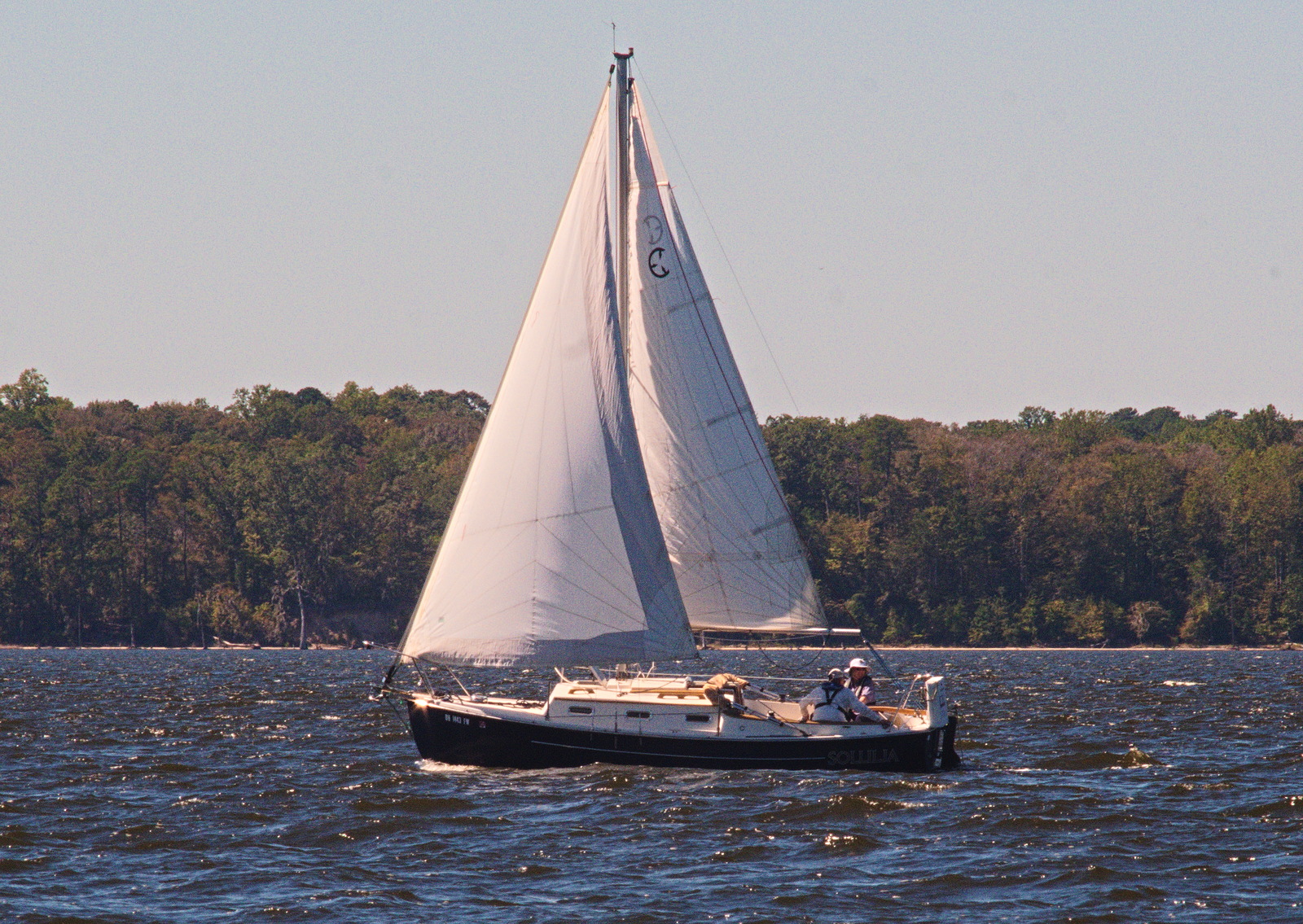
Another Com-pac, this one a sloop. Photograph by Paul Clayton.
Text by Paul Clayton, photographs by Paul Clayton and David Swanson. Posted 12/28/25.
Copyright © 2026 Paul M. Clayton, David Swanson.